April 01, 2026
Photogrammetry, spatial scans, and reconstructed environments
Point Clouds is an ongoing body of experimental work exploring photogrammetry and 3D scanning as a form of image-making.
Rather than capturing a single frame, photogrammetry reconstructs an object or space from multiple angles, creating a form that sits somewhere between photography, sculpture, and memory. The resulting image feels less fixed and more spatial, as though it can still be entered, rotated, or broken apart.
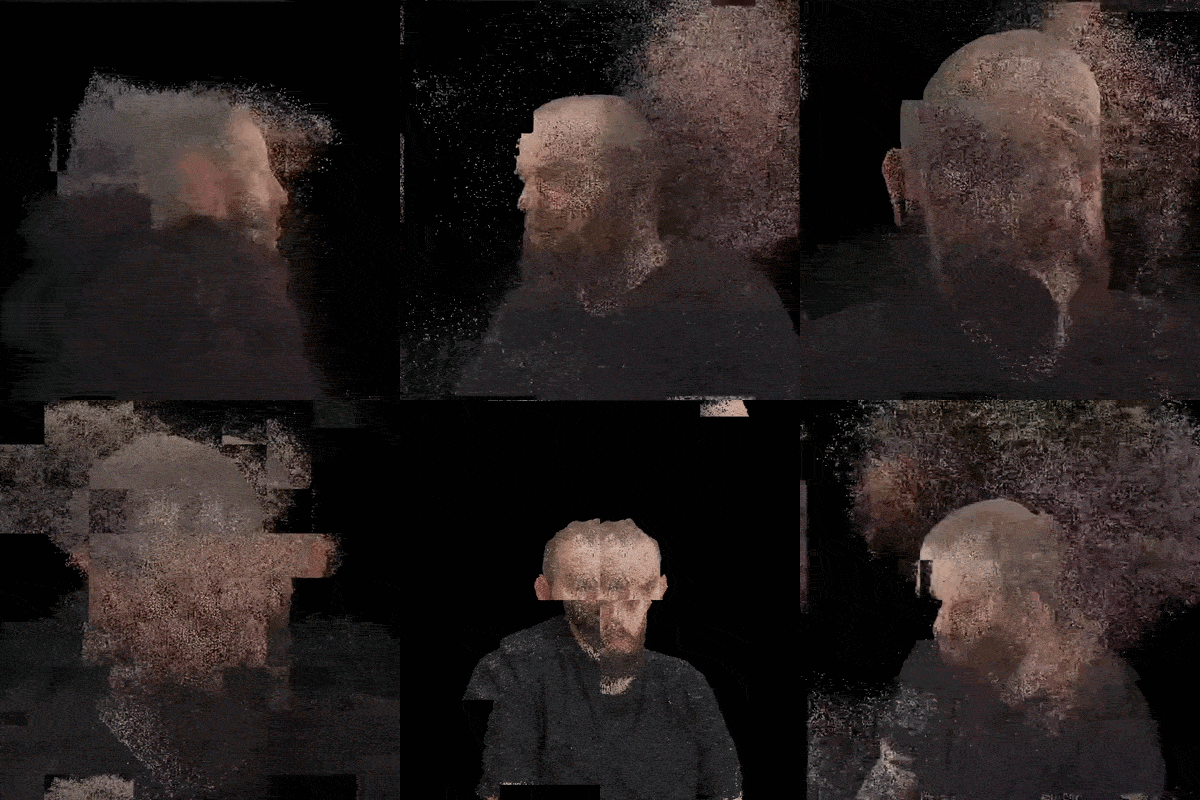
What interests me most is the instability of the medium. The scans are often most compelling when they don’t fully resolve, when surfaces tear, geometry fragments, and familiar forms begin to resemble partial reconstructions rather than polished models.
That tension between accuracy and distortion is what gives the work its visual pull. A flower, sculpture, room, or self-portrait can begin as documentation and quickly become something much stranger once translated into a point cloud or gaussian splat.
I’ve been using this process to build a growing library of scanned forms, including floral arrangements, sculptures, interiors, and self-portraits. Some of the most interesting results have come from objects that already carry a strong sense of volume, texture, or symbolic weight before they’re scanned.
The process is mostly iPhone-based at the capture stage, then refined in Blender or MeshLab before being brought into TouchDesigner. Once there, the scans become material for further manipulation through motion, sound, distortion, and real-time systems.
Some of these studies have already evolved into audio-reactive visuals, while others feel like early fragments of future projection work or immersive environments. What matters most to me is that they remain open, unfinished, and available for transformation.
Final Thoughts: What interests me most about point clouds is their ability to hold onto the shape of something while still letting it fall apart.